Home › Composite decking
Composite Decking in Hamilton
Boards made from wood fibre and plastic that are washed, never stained. They cost more on day one and ask very little after that.
- No oiling, staining or sanding
- Hidden clips for a clean, screw-free surface
- Frame built to the board maker's joist spacing
Get a free quote
Tell us about the job. We reply within one working day.
The usual reason people in Hamilton ask about composite is the upkeep on the deck they already have. A timber deck on the shaded side of a house here goes green over winter and wants washing and re-coating every year or two. Composite boards still need a wash, but that is the whole job.
They are not a straight swap for timber, though. The boards are heavier and more flexible, they move with heat, and each maker sets its own rules for joist spacing and gaps. A composite deck built like a pine deck will sag and buckle.
What composite boards are
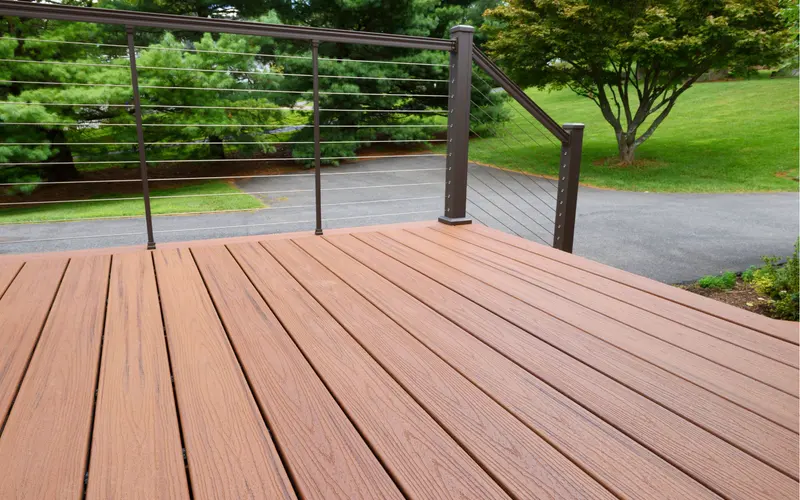
Most are a blend of recycled wood fibre and plastic, pressed into a board. Older or cheaper boards are the same mix right through. Capped boards have a tough plastic skin on the outside that resists stains and fading much better, and are the ones worth paying for. Some ranges are hollow to save weight and cost. Solid boards feel firmer and cope better with cut edges and curves.
How the build differs from timber
- Closer joists. Often 400 mm or less, and closer again where boards run on an angle. More joists means more timber in the frame.
- Hidden clips. Grooved boards clip to the joists, so no screw heads show. The edge boards and steps are still face-fixed or finished with a trim board.
- Room to move. Boards grow and shrink along their length with temperature. End gaps are set for the day they are laid, and long runs are broken with a border board.
- Airflow. Makers ask for clear space under the deck. Tight to the ground with closed-in sides is where composite decks fail.
Heat, colour and slip
Dark composite gets hot in a Waikato summer, hot enough to notice in bare feet on a north-facing deck. Mid and light greys and browns stay cooler. Colour settles a little over the first few months and then holds. Most boards have a brushed or embossed grain for grip, but like any deck in this climate a shaded board grows a film over winter and needs a scrub. The decking types guide sets composite beside pine and hardwood.
Composite deck prices
| Item | Guide price |
|---|---|
| Composite deck, built | $800 to $1,300 per m² |
| Kwila, vitex or garapa deck, for comparison | $700 to $1,100 per m² |
| Treated pine deck, for comparison | $450 to $750 per m² |
| Raised or sloping site | Add 25 to 50 percent |
| Removing an old deck | $600 to $1,800 |
Guide prices for materials and labour together. The firm price is the written quote you get after a site visit.
Questions about composite decking
How much does a composite deck cost?
As a guide, $800 to $1,300 per square metre built, on a flat site. That makes a 20 square metre composite deck $16,000 to $26,000. The boards and the extra joists are both dearer than for pine.
How long does composite decking last?
Good capped boards are made for 25 years or more, and the treated timber frame underneath usually lasts as long. The maker's warranty terms differ between products, so read what the one you choose actually covers.
Can composite boards go on my existing deck frame?
Only if the frame is sound and the joists are close enough for the board. Many older frames have joists at 600 mm, which is too wide. Extra joists can sometimes be added between the old ones. The builder checks this at the site visit.
Does composite decking get slippery?
No more than timber, and usually less when it is clean. In a damp, shaded spot it still needs a wash with a soft brush and deck cleaner once or twice a year.
Does a deck need a building consent?
Not when it is impossible to fall more than 1.5 metres from it. Higher decks need a consent, and any deck where you could fall a metre or more needs a balustrade. Roofed structures and pool barriers have their own rules. Confirm what applies to your property with your council.
Who actually does the building?
An independent Waikato building company that we partner with. They come to the site, give you the written quote and do the work under their own name.
Four steps, start to finish.
Send the details
Use the form or phone. A rough size, what is there now and your suburb is plenty to begin with.
Site visit
The builder measures, checks floor height, ground and access, and talks through boards, steps and rails with you.
Written, itemised quote
Frame, boards, steps, balustrade and any consent costs shown as separate lines, with a start date. No obligation.
Build and hand-over
The same builder from set-out to the last screw. You walk the finished job together before the final invoice.
Get a quote for composite decking
Fill in the form and we will line up a free site visit and a written quote with every cost listed. Or phone and talk it over first.
Request a free quote
Tell us about the job. We reply within one working day.